
ZXN Studio vs Screen Studio
Compare Screen Studio’s automatic recording polish with ZXN Studio’s multi-track control, including Mac audio capture, requirements and export checks.
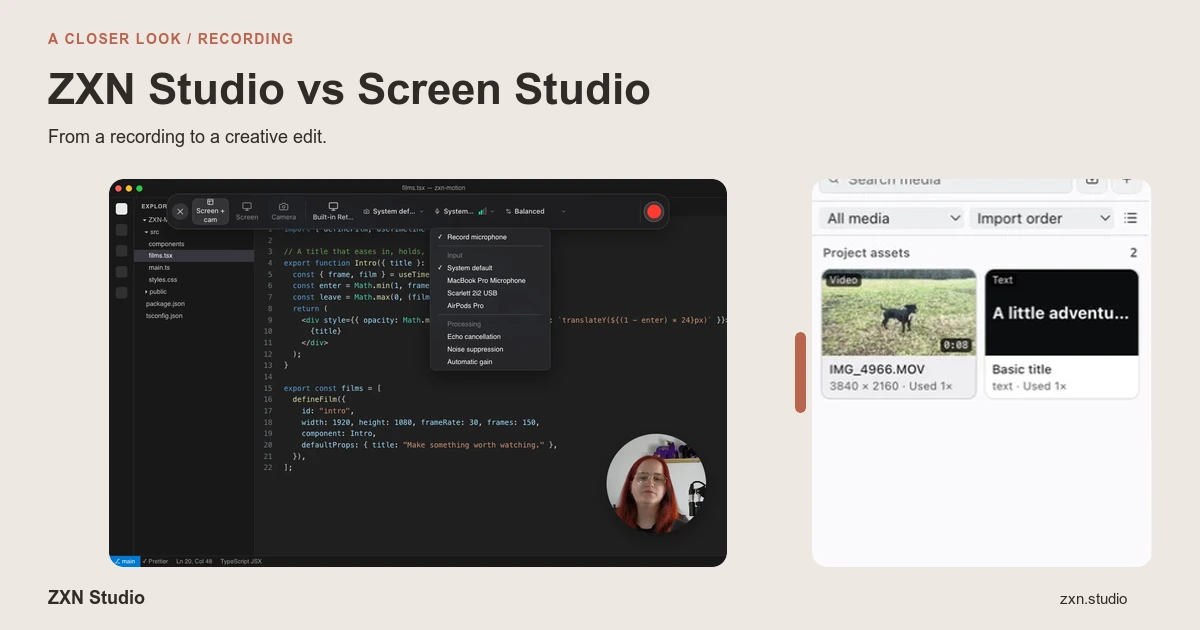
Screen Studio and ZXN Studio both deserve consideration for Mac screen videos, but they emphasise different workflows. Screen Studio's official site highlights automatic zoom and cursor presentation around recordings. ZXN Studio combines recording with a creative multi-track editor for deliberately arranging footage, titles, effects and motion. The choice is how much automatic presentation you want and what you need to control afterwards.
This comparison is current as of 19 September 2026. Screen Studio facts come from its official pages; this is not a timed benchmark or a claim of feature-for-feature parity.
Automatic zoom or deliberately placed movement?
Screen Studio's Auto Zoom guide explains that automatic zoom focuses on recorded click locations. It also notes that an area without a click requires manual selection rather than an automatic target. That distinction matters for demonstrations where the important event is a result appearing elsewhere, not the button you pressed.
ZXN Studio supports transforms and keyframes, allowing you to build movement around the explanation. That does not establish identical cursor-aware zoom automation, so do not assume the two approaches are interchangeable.
For a fair test, include a click, a keyboard-driven action and a result appearing away from the cursor. Judge whether the viewer can follow all three without unnecessary reframing.
Mac system audio is a concrete difference
Screen Studio officially documents system-audio recording, including choosing audio from all applications or selected applications. That is relevant for software demonstrations in which internal playback is part of the evidence.
ZXN Studio's Mac recorder captures screen, camera and a microphone or audio-interface input. Its current desktop/system-audio capture is Windows-only. Recording a microphone successfully does not change that limitation.
When your project depends on Mac application audio, give this difference priority over decorative features. Check Screen Studio's current requirements and test the relevant sound source, or establish another verified capture workflow before planning to edit in ZXN Studio.
Consider what happens after the first take
ZXN Studio keeps completed screen and camera recordings separately editable. Its editor supports trims, splits, layers, transforms, opacity, blend modes and keyframes, so the final composition need not remain the layout you first recorded.
It also provides titles, effects, colour corrections, wheels, curves, local background removal and source-backed editable TSX motion graphics. These are relevant when the recording becomes part of a wider creative sequence rather than remaining a single demonstration.
Screen Studio also advertises editing and customisation on its official site. Do not describe it as having no editing tools. Instead, test the specific revision you expect to make, such as changing emphasis midway through the video or presenting a dense interface without obstruction.
Check operating-system requirements independently
Screen Studio's requirements guide lists macOS Ventura 13.1 or later and provides its processor and memory guidance. Read the full current page for your particular Mac rather than applying its requirement to another recorder.
ZXN Studio's current native recorder targets macOS 26 or later. That is a recorder requirement, not a claim that every possible media and effects workload performs identically on every eligible machine.
Use ZXN Studio's setup checks and a representative test to verify recording, editing and export. An application launching is not the same as a completed workflow.
Compare the output you actually need
Screen Studio advertises video export up to 4K at 60 fps, GIF export and shareable links on its official product page. Verify the current plan conditions and output controls before designing around a particular delivery route.
ZXN Studio Free includes recording/export up to 1080p at 30 fps. Studio adds 4K, 60 fps and supported native ProRes masters. Other current export choices include MP4 H.264/AAC, MOV H.264/AAC and WebM VP9/Opus.
These lists do not establish identical export behaviour. Test the intended format in the destination where it will be watched or edited, following ZXN export guidance.
Choose a plan after testing the composition
ZXN Studio's paid Studio plan costs $15.99 USD monthly or $159 USD lifetime. Monthly renews until cancelled; lifetime is one payment. Payments use Stripe, account access supports up to two connected devices, and optional AI/Codex services may have separate requirements or charges.
Free includes plain titles, six filters, six effects, three camera frames and people removal using RVM. Studio adds the expanded creative set, including all cutout models and live background removal. Studio-only treatments may be previewed in Free, but export identifies clips requiring Studio.
Check Screen Studio's current official pricing rather than assuming a historical licence offer remains available. Compare what you can deliver under each purchase, not only what a preview lets you explore.
Use one real demo to decide
Record the same short task, refine the framing and export it in each candidate workflow. Check readability, audio, camera placement and the effort needed to correct an awkward moment. Do not infer exported results solely from live or timeline previews.
Choose Screen Studio when its verified recording automation and capture features match your priorities. Choose ZXN Studio when separately editable recordings and deliberate multi-track composition are central. The stronger choice is the one that completes your actual demonstration with the fewest unacceptable compromises.